Ab Exercises After 50: The Myth Costing Men Their Backs
The single leading cause of disability on the entire planet is not cancer. It is not heart disease. It is not diabetes.
It is back pain. And the age group carrying more of it than any other is people in their 50s. That is us, right now.
Here is what makes it worse. The muscle group holding all of this together is the exact one almost every man I know quit training twenty years ago.
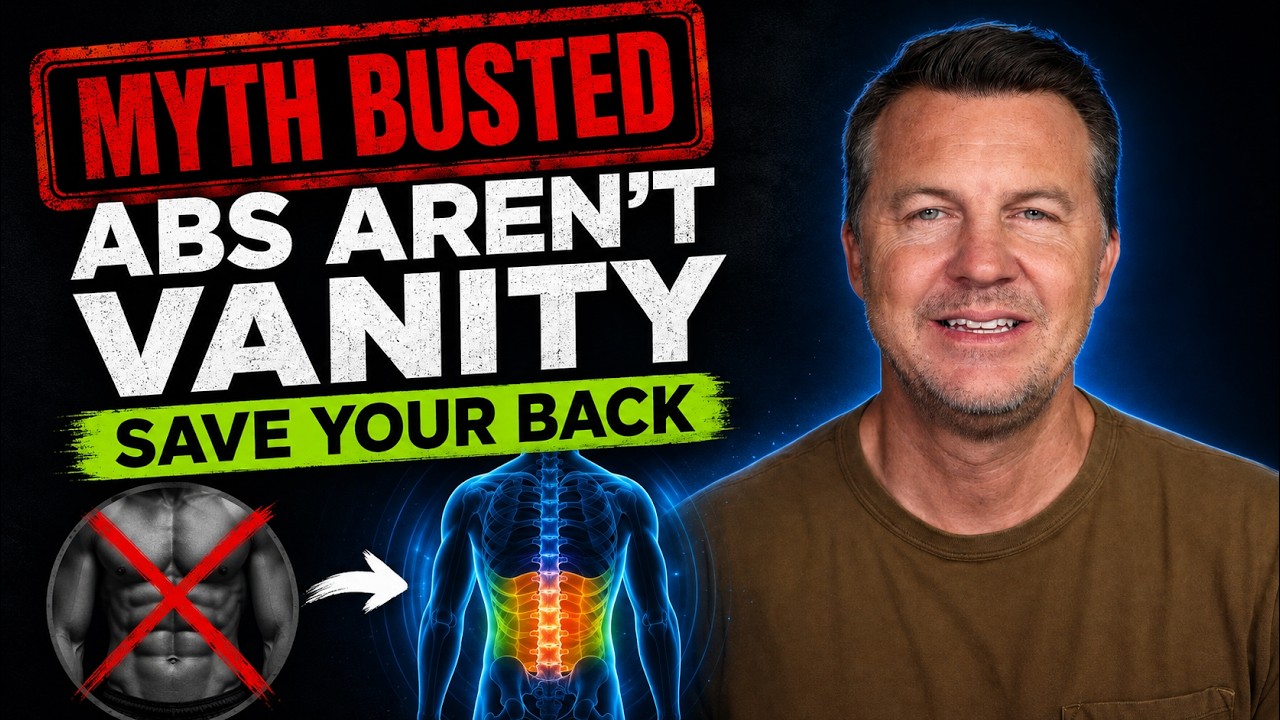
We quit because of a myth — the myth that abs are all about looks. Six-pack, beach body, vanity. Something you chase in your 20s and give up on around 40. When the mirror stopped mattering, so did the muscle.
But abs were never about the mirror. They are the reason you can still get off the floor at 75. So this post covers the myth, why it is wrong, and the ab exercises after 50 that are actually worth ten minutes of your week.
Table of Contents
Why every man I know quit training his core
The myth is wrong in two different directions at the same time. First, ab exercises were never going to give you the look anyway. Second — and this is the bigger one — the look was never the point. While everyone was arguing about how abs look, nobody mentioned what they actually do.
Let me take those one at a time.
You cannot spot reduce fat
Work a muscle and the fat sitting on top of it does not care. Your body pulls fat from everywhere, all at once, and it decides where — not you.
This has been tested directly. In one study, participants did six weeks of dedicated ab training, five days a week, measured before and after. The abs got fitter, and the belly did not change. Not body fat. Not waist circumference. Nothing.
So if you did crunches for years and got nowhere, you were not doing it wrong. It was never going to work.
Your core is a cylinder, not a six-pack
Quick correction first, because “abs” is probably the wrong word. Your core is a cylinder — muscles wrapping all the way around you like a corset, plus the ones running alongside your spine and your back. It fires before your arms and legs do, every single time you move.
That cylinder is buying you three things, and none of them show up in a mirror.
It is what lets you train everything else
This is the one nobody says out loud, and I think it is the biggest one. You cannot safely load a squat, a deadlift, or a heavy carry without a core that holds. And those are the movements that actually change your health after 50: they build muscle, they improve how you handle blood sugar, they load your bones.
Your core is not the payoff. It is what lets you go get the payoff. When it is the weak link, you either train around it or you get hurt. Neither one is where the results are.
Same story with the fat. The fat packed deep behind your abdominal wall — not the stuff you can pinch — feeds straight into your liver and drives your triglycerides and blood sugar up. I am fighting that exact number right now in my 90-day plan to lower triglycerides. Ab work will not burn it off your belly specifically. But hard training burns it, and a solid core is what lets you train hard enough to matter.
It keeps your back working
Your spine is a stack of bones that is not stable on its own. The muscles around it hold that stack together while you load it. Let them weaken for thirty years and you are lifting groceries with an unsupported spine.
That disability number I opened with — number one on the planet — has held that spot since 1990, and the World Health Organization puts the peak number of cases right in the 50 to 55 age group. This is where it lives.
I will be straight with you, though. Nobody has proven that weak abs cause back pain. What we do know is that exercise reduces it — and exercise is exactly what most men our age stopped doing.
It keeps you on your feet
Falls are the leading cause of injury-related deaths for adults over 65, and the number is going the wrong way: the CDC reports the death rate climbed 21 percent between 2018 and 2024.
Balance and leg strength matter most there. But catching yourself is a core event before it is a leg event. It is the same system behind carrying something heavy on one side without listing, and behind standing up straight at the end of the day.
Here is a test worth trying today. Sit down on the floor. Then stand back up without using your hands and without pushing off a knee. Most men our age can still do it. Fewer can at 65. And whether you can at 75 is being decided right now.
The five ab exercises after 50 actually worth your time
Here is the good news: this takes ten minutes, once or twice a week. Three or four exercises, three sets of 10 to 20 reps. That is the whole prescription. These are the five I use:
- Seated weighted crunch. On the ab machine, or seated on a bench holding a plate at your chest. Curl your ribs down toward your hips and control the weight in both directions — no yanking, no momentum. 10 to 20 reps, 2 to 3 sets.
- Declined weighted sit-up. Feet hooked, plate held against your chest. Come up under control and lower yourself down slowly — the way down is where most of the work is. Start with no weight until the movement feels clean. 10 to 15 reps, 2 to 3 sets.
- Captain’s chair knee raise. Forearms on the pads, back flat against the pad behind you. Bring your knees up under control and do not swing them. 10 to 15 reps, 2 to 3 sets.
- Back extension. On the 45-degree or flat bench, hinge down and come back up until your body is a straight line — do not crank past it into an arch. This trains the muscles running alongside your spine, and they matter more for your posture and your back than the six-pack ever will. If you have ever seen a man in his 70s bent forward and wondered how that happened, it starts here. 10 to 15 reps, 2 to 3 sets.
- Cable Pallof press. Set a cable at chest height and stand side-on to it, pressing the handle straight out from your chest. The machine is trying to twist you; your job is to not let it. Press out, hold a second, bring it back. 10 to 15 reps each side, 2 to 3 sets. This one trains what your core actually does in real life — resisting the twist when something pulls on you, which is exactly what happens when you catch yourself in a stumble.
The whole prescription
Pick two or three: one for the front, one for the back, and one that resists rotation. That is a complete core workout. Add weight when 20 reps stops being hard — that is the progression.
Once or twice a week is enough, because your core is already working in every squat, deadlift, and carry you do. This is a supplement, not a main course.
One thing worth saying. The first two movements load your spine into a curl. If your lower back does not like that, swap them: planks, side planks, and dead bugs train the same muscles without bending your spine under load. And if you have a bad back, a hernia, or you have had abdominal surgery, check with your doctor before you do any of this. Actually — check with your doctor before you start any new exercise program anyway, especially if it has been a while.
The floor test, and your own numbers
So remember: abs are not vanity. Your core is what lets you train everything else. It keeps your back working, it keeps you upright when you stumble, and it is what gets you off the floor unassisted at 75. Three sets, 10 to 20 reps, once or twice a week. Start there.
If you want to understand the numbers underneath this — triglycerides, blood sugar, what optimal means versus normal — I put together a free Biomarker Decoder that walks through all of it.
Every number I report about myself is public on my Scorecard, retested every quarter. And subscribe on YouTube so you catch the October retest.
Then try the floor test and tell me in the comments on the video how it went. Be honest — I want to know how many of us are in the same boat.
I am Joe. This is Function Over 50. And we are just getting started.
Sources: World Health Organization fact sheet on low back pain (2023); Global Burden of Disease studies on low back pain as the leading cause of disability since 1990; Vispute et al., randomized trial of abdominal exercise and abdominal fat (2011); CDC data on falls among adults 65 and older (2018–2024).
I am not a doctor and nothing here is medical advice. This is my own experience and general information only. Check with a qualified physician before starting any new exercise program — especially if it has been a while, or if you have back problems, a hernia, or prior abdominal surgery.