How Many Sets to Build Muscle After 50? Why Three Isn’t a Rule
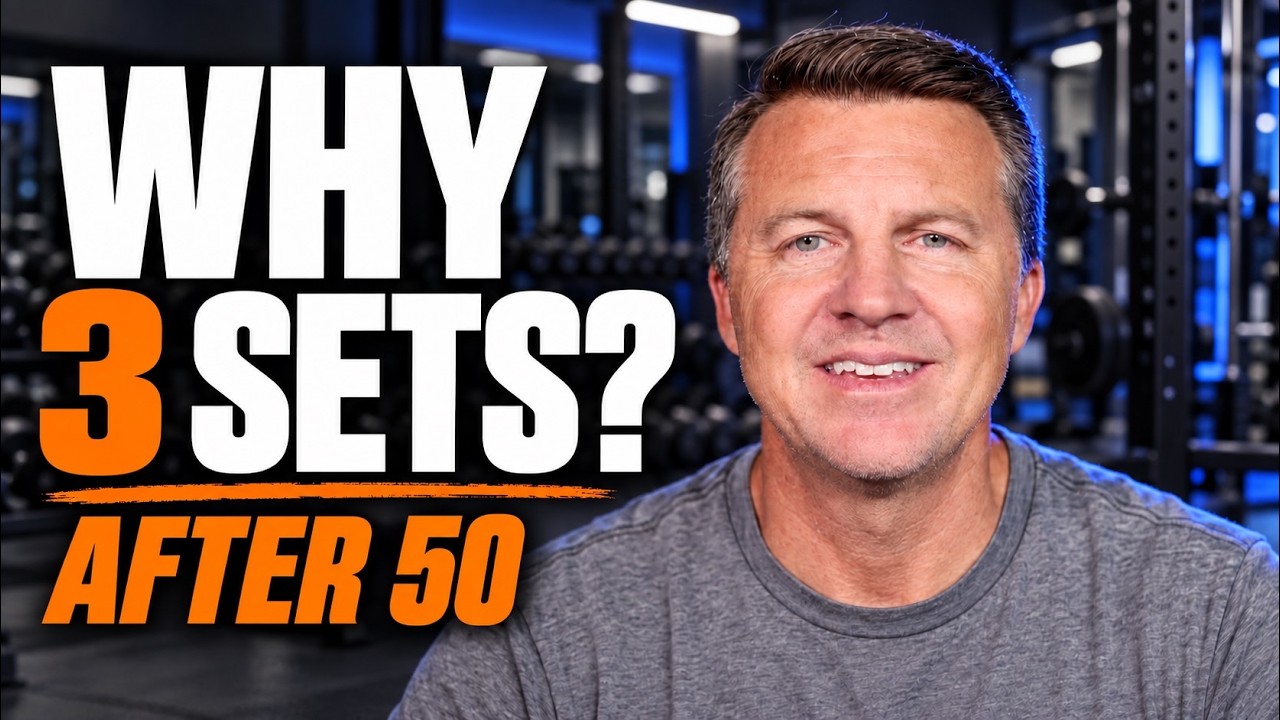
Why do they always tell you to do three sets?
Three sets of bench press. Three sets of incline press. Three sets of flyes. By the time you finish, your chest has not done three sets. It has done nine.
I’m 50, and I’m not looking for the smallest workout I can get away with. I want the best results from the work I put in. That means asking a better question: would another set help me build more muscle, or give me very little extra for the effort?
Two or three challenging sets per exercise can be a reasonable starting framework. But changing exercises does not reset the work a muscle has already done.
One hard set can work. That does not mean it works best.
In the video, I discuss Mike Mentzer and Dorian Yates because their approaches make the one-set argument interesting. But one main working set per exercise is not necessarily one set for the entire muscle. And one person’s success cannot tell us what would have happened with a different program.
A meta-analysis of single versus multiple sets found that multiple-set programs generally produced greater muscle-growth effects than single-set programs. The comparisons between specific set ranges were less certain, so this is not proof that exactly three sets is the magic number.
The distinction matters: can build muscle and builds the most muscle are different claims. One demanding set is not useless. It also does not automatically replace several challenging sets.
More sets may help—with diminishing returns
If another set can help, why not keep going until you have done 10, 15, or 20?
Because additional benefit does not necessarily rise in proportion to the amount of work.
A 2026 resistance-training dose-response meta-analysis found that greater weekly set volume was associated with greater muscle growth, but with diminishing returns. The extra benefit tended to get smaller as volume increased. That is different from saying all sets beyond a particular number are wasted.
A shorter workout might give me more benefit per minute. A longer workout might still produce somewhat more growth. Those are different goals, and I do not want to confuse efficiency with maximum results.
There is an important limit to what we can conclude: this research examines weekly volume. It does not hand us an exact stopping point for today’s chest workout. The participants in that analysis were also mostly young adults, with an average age around 25—not a group of men over 50.
A starting framework for sets after 50
For someone already lifting and training a muscle about twice a week, here is the practical framework I take from the evidence and expert guidance:
- Two or three challenging working sets per exercise.
- Roughly six to 10 total working sets for that muscle in a session.
- A manageable amount close to what you are already accustomed to.
This is my interpretation, not a scientifically established optimum for everyone over 50. It is not a requirement to jump to six sets if you are a beginner, returning after a break, or currently doing much less. Your experience, exercise choices, health, and recovery all matter.
These numbers refer to challenging sets after you are prepared to lift. Light warm-up sets still matter, but they are not the same as the working sets being counted here.
The IUSCA position stand on muscle hypertrophy suggests distributing additional volume across sessions when approaching roughly 10 sets for a muscle in one workout. That is expert planning guidance for an athletic population—not a biological wall where set 11 stops working.
Count the muscle’s total—not just the exercise’s sets
Here is an example chest session, not a prescription:
| Exercise | Working sets |
|---|---|
| Bench press | 3 |
| Incline press | 2 |
| Flyes | 2 |
| Total for chest | 7 |
Seven is an example. It is not proof that seven beats six or eight. And nine sets is not automatically too many.
The point is to see the whole session. If I add another chest exercise, I am adding more chest work—not starting from zero again.
There is overlap, too. Presses involve the triceps as well as the chest. The newer dose-response analysis distinguishes direct work from work where a muscle assists. I would not automatically count every press as a full direct triceps set, then pile on the same amount of isolation work as if the triceps had done nothing.
Does training to failure change the set count?
Could one all-out set replace two or three sets stopped just short of failure? We do not have a reliable conversion formula like that.
In an eight-week study of resistance-trained adults, stopping leg presses and leg extensions with one or two repetitions in reserve produced similar overall quadriceps growth to reaching failure, with less immediate fatigue. It was a small, specific study—not proof that every muscle, program, and age group responds identically.
It shows that a set can be productive without failing the final repetition. It does not show that one failure set replaces several challenging sets.
I covered the effort side in more detail in Training to Failure After 50: Does Every Set Need It? For comparing set numbers, I want reasonably consistent effort and technique. More weight is not the same thing as more effort, and extra easy sets are not a fair comparison with fewer demanding ones.
I am not forcing repetitions through joint pain or letting technique fall apart just to make a number count. The National Institute on Aging’s exercise guidance emphasizes warming up, gradual progression, proper form, and listening to your body.
How I would test whether another set is worth it
The useful question is not whether I can survive more work. It is whether more work improves the results I can recover from and repeat.
- Establish a consistent baseline. Record exercises, working sets, weight, repetitions, and estimated reps in reserve.
- Look across several weeks. One bad workout or one great pump does not settle the question. Follow performance and recovery, alongside longer-term measurements of muscle size.
- Change a small amount. If recovery is good and I want to test more volume, I might add one set while keeping other variables reasonably consistent.
- Review the whole picture if performance slips. Fatigue, rest between sets, sleep, and nutrition deserve attention before I automatically add more work.
Getting stronger is useful information, but it does not prove I have maximized muscle growth. I want a log that helps me make decisions, not just a workout that leaves me exhausted.
This connects with the broader issues in 5 Mistakes Stopping Muscle Growth After 50 and my look at how much protein I need to build muscle after 50.
Make the nutrition side easier
If figuring out what to eat is slowing you down, the free Function Over 50 High Protein Playbook offers practical meal ideas to help you work toward your protein target.
The bottom line
Three sets is a reasonable starting number, not a commandment for every exercise. Count the total work for the muscle, remember that more can help with diminishing returns, and do not mistake a planning guideline for a universal optimum.
For an established lifter training a muscle about twice a week, two or three challenging sets per exercise and roughly six to 10 total in a session gives me a framework to evaluate—not a number to force onto everybody.
I am not trying to do less just to leave sooner, or more just to feel exhausted. I am trying to find the amount of training that produces the best results I can consistently recover from.
Sources and further reading
- Krieger, 2010: single versus multiple sets and muscle hypertrophy
- Pelland and colleagues, 2026: weekly volume, frequency, and diminishing returns
- IUSCA, 2021: resistance-training recommendations for muscle hypertrophy
- Refalo and colleagues, 2024: failure versus one to two repetitions in reserve
- NIH National Institute on Aging: muscle-strengthening exercise and safety
This article is for educational purposes and documents how I interpret the research. I am not a doctor, dietitian, or trainer. It is not personalized medical or exercise advice. Consult your physician or another qualified professional before beginning or changing a program, especially if you have an injury, chronic condition, or other health concern.