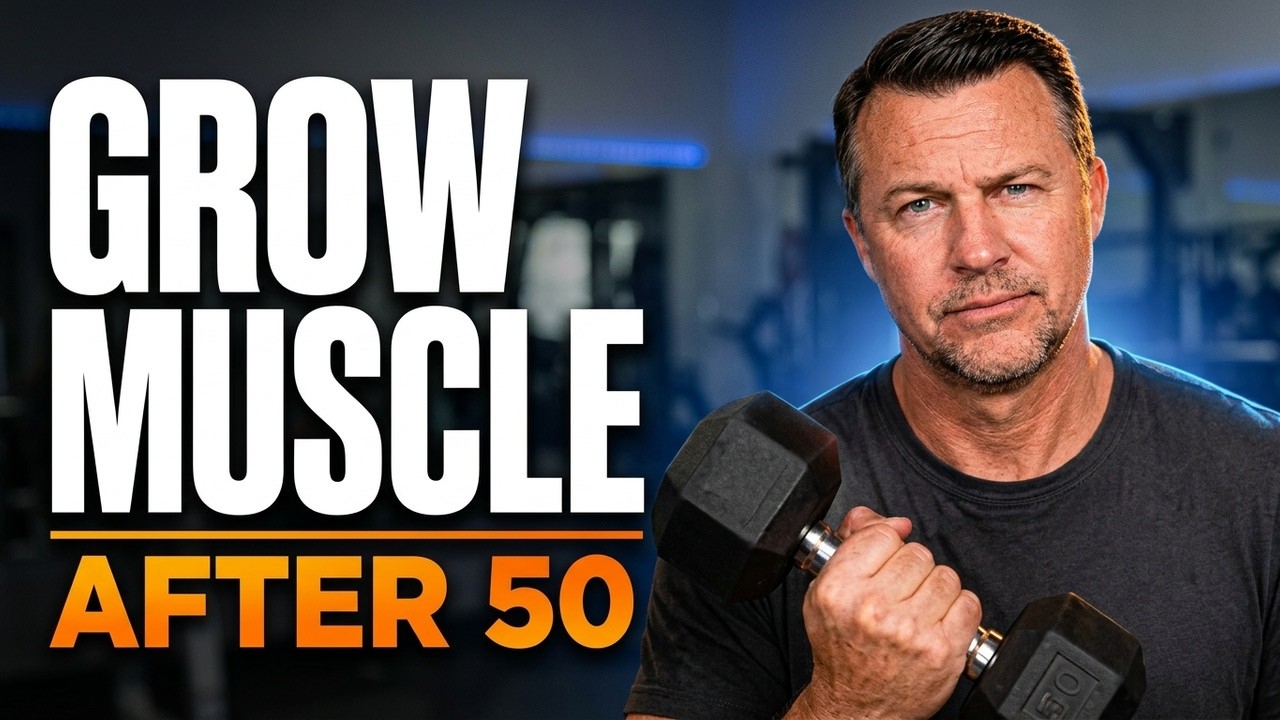
5 Mistakes Stopping Muscle Growth After 50
If you’re over 50 and trying to build muscle, two bad assumptions can stop you before you really get started.
The first is that you’re simply too old to build new muscle. The second is that you should train exactly the way you did when you were 25.
Both miss the mark.
The research is clear that people well into their 60s, 70s, and beyond can still build measurable new muscle through resistance training. But aging can change recovery, hormones, joints, and the margin for error. Harder does not mean impossible, and smarter does not mean fragile.
So the real question is not whether I can build muscle after 50. It is why so many people lift weights every week without seeing much growth.
I’ve been digging into that question because I’m trying to add muscle myself. I found five mistakes that may explain a lot of stalled progress—and one of them is something I realized I had not been taking seriously enough.
I’m not a doctor, dietitian, or trainer. I’m a 50-year-old guy figuring this out and showing my work. I’m going to measure what happens rather than pretending I already know the outcome.
First, can you really build muscle after 50?
A 2024 systematic review and meta-analysis examined resistance-training studies in adults age 65 and older. Across the included trials, resistance training produced statistically significant average improvements in whole-muscle size and muscle-fiber area.
That does not mean everyone responds equally or that age is irrelevant. It does mean “I’m too old to grow” is not supported by the evidence.
The National Institute on Aging also describes strength training as a way older adults can maintain muscle, improve mobility, and preserve independence. For me, that is the real prize. This is not just about looking better in a T-shirt. It is about building reserve capacity for the decades ahead.
Mistake #1: Not actually challenging the muscle
A lot of exercise advice for people over 50 boils down to using light weights, avoiding effort, and “just keeping moving.” Staying active is valuable, and protecting an injury matters. But being smart and being afraid to challenge yourself are not the same thing.
You do not necessarily need extremely heavy weights to build muscle. You also do not need to take every set to absolute failure. A systematic review of training proximity to failure found no clear evidence that reaching momentary failure is always superior for hypertrophy.
But the set still needs to create a meaningful stimulus.
If I choose a weight I could curl 25 times, perform 10 easy repetitions, and put it down without slowing down or concentrating, what reason have I given my body to adapt?
Probably not much.
The final repetitions of a productive set should normally feel different from the first few, even when I stop short of failure. My muscles cannot read my driver’s license. They respond to the work I ask them to do.
Mistake #2: Working out without progressing
I can train hard and still stall if I repeat the same workout forever.
If I use the same exercise, weight, repetitions, range of motion, and number of sets month after month, my body eventually becomes accustomed to that demand. Progressive overload simply means that something improves over time.
That might mean:
- Adding a repetition with the same weight
- Increasing the load when I can do so with good form
- Improving control or range of motion
- Adding a productive set when recovery supports it
- Performing the same work with better technique
The National Institute on Aging’s guidance similarly describes gradually increasing the weight, repetitions, sets, or training frequency as strength improves.
This is where the Function Over 50 philosophy carries directly into the gym. I measure blood work, sleep, body composition, and daily activity. It makes no sense to guess about my training.
If I do not record what I lifted, I cannot reliably tell whether I’m progressing.
Mistake #3: Doing more instead of doing enough
Once progress becomes the goal, it is easy to assume that more training must produce more growth.
The American College of Sports Medicine recently synthesized 137 systematic reviews covering more than 30,000 participants. Resistance training improved strength and muscle size, and training volume mattered for hypertrophy. But the larger message was refreshingly simple: consistency matters more than unnecessary complexity.
More work only helps if it is productive work I can recover from. Doubling my sets does not mean I will grow twice as fast. At some point, extra work may create fatigue that lowers the quality of future sessions.
Research in older adults also suggests that excessive volume can work against progress, although the ideal amount varies by person, training history, exercise selection, and health status.
The useful question is not, “How much training can I survive?”
It is, “How much quality training do I need to stimulate progress while still recovering well enough to repeat it consistently?”
I am looking for the smallest dose that keeps producing measurable progress, then adjusting from the evidence in my own training log.
Mistake #4: Not feeding what you’re trying to build
A lot of us want to lose the belly, drop 20 pounds, gain muscle, and become stronger—all while eating less and less.
The body does not care about my wish list.
Training supplies the signal to build. Nutrition supplies the raw materials. Protein matters, but so does total energy intake.
A meta-analysis of resistance training during an energy deficit found that prolonged energy deficiency impaired gains in lean mass on average, even though strength improvements were not clearly reduced. That does not mean fat loss and strength training cannot coexist. It means aggressive dieting may make gaining new tissue harder.
The NIH Office of Dietary Supplements explains that adequate dietary protein supplies the essential amino acids used to build and repair muscle. Research on adding protein supplements to resistance training in older adults is more mixed: some reviews show modest improvements in muscle or lean mass, while effects on strength are less consistent.
So I am not treating a shake, powder, or precise timing trick as magic. My first priorities are understanding my usual intake, eating enough to support the goal, and getting adequate protein from a sustainable diet.
Individual needs differ, especially for someone with kidney disease or another medical condition. That is a conversation to have with a physician or registered dietitian—not a target to copy blindly from someone online.
I also do not want to look at muscle gain in isolation. If I change calories, protein, supplements, or training, I want to see what happens to my blood sugar, lipids, body fat, hormones, and the rest of my health. Bigger arms are not much of a win if everything else moves in the wrong direction.
Mistake #5: Ignoring recovery
This is the mistake I underestimated most.
At 25, I could train hard, sleep five or six hours, eat badly, and somehow do it again the next day. At 50, I do not think I have the same margin for error.
That does not mean I need to train like I am old. It means recovery is a variable I need to take seriously.
The workout creates the stimulus. Adaptation happens afterward. Sleep, nutrition, time between hard sessions, stress, and dealing with small aches before they become major problems all matter.
The National Institute on Aging says adults generally need seven to nine hours of sleep, while needs and sleep patterns vary. Research has also found associations between short sleep and sarcopenia, but those observational findings do not prove that one causes the other.
In other words, I am not claiming that one short night destroys muscle growth. I am saying sleep is an important input worth measuring rather than dismissing.
I discovered that I was averaging about six and a half hours a night. That finding led to my separate experiment on sleep after 50. Now recovery will be tracked alongside the weights instead of treated as whatever time is left over.
The muscle-building experiment I’m starting at 50
When I put all five mistakes together, the plan becomes surprisingly simple:
- Train consistently. Build a schedule I can repeat instead of chasing a perfect routine.
- Make the sets count. Challenge the target muscle while keeping technique and joint safety in view.
- Record every session. Track exercises, weight, repetitions, sets, and how difficult the work felt.
- Progress deliberately. Improve one useful variable when performance and recovery support it.
- Eat for the actual goal. Track energy and protein rather than assuming I am eating enough—or too much.
- Measure recovery. Watch sleep, soreness, pain, energy, and performance before automatically adding work.
I am establishing a baseline with body composition, measurements, strength, nutrition, sleep, activity, and blood work. Then I am going to track all of it—not just the numbers that make me look good.
Can I build measurable muscle at 50? How much? How long will it take? What happens to my strength, body fat, sleep, and blood work? Which variables appear to make the biggest difference for me?
I genuinely do not know yet. That is the point.
You can follow the experiment and see my weekly numbers on the Function Over 50 Scorecard.
This is about capacity, not turning back the clock
I am not trying to become a bodybuilder or pretend I am 25 again.
I want enough muscle and strength to keep traveling, surfing, carrying heavy things, getting off the floor, training, and doing things with my family. I want a larger reserve between what everyday life demands and what my body is capable of doing.
That is what Function Over 50 means to me. It is not about pretending we are not getting older. It is about staying as capable as possible while we do.
If you are working on your own health and trying to understand the numbers on your lab report, download the free Function Over 50 Biomarker Decoder. It explains many common blood markers and can help you prepare better questions for your healthcare provider. It does not diagnose disease or replace medical care.
What has been your biggest obstacle: building muscle, getting stronger, staying consistent, eating for the goal, or recovering? Share it in the comments, and follow along as I put this plan to the test.
Medical disclaimer: This article is for informational and educational purposes only and is not medical advice. Consult your physician or another qualified professional before beginning or changing an exercise program, diet, supplement, medication, or lifestyle routine—especially if you have an injury, chronic condition, or other health concern.
Sources and further reading
- Lower-extremity muscle hypertrophy from resistance training in adults 65 and older — systematic review and meta-analysis
- American College of Sports Medicine position stand on resistance-training prescription
- U.S. Department of Health and Human Services Physical Activity Guidelines for Americans
- National Institute on Aging: Muscle-strengthening exercise for older adults
- Resistance-training proximity to failure and muscle hypertrophy — systematic review
- Energy deficiency, resistance training, and lean-mass gains — meta-analysis
- NIH Office of Dietary Supplements: Exercise and athletic performance
- CDC: About sleep and recommended sleep duration