Buying Protein Powder After 50? Check These 3 Things First
Buying a more expensive protein powder does not mean you are buying more muscle. But grabbing the cheapest tub does not necessarily mean you are saving money, either.
I am trying to build muscle at 50, and I am willing to pay for something useful. What I do not want to pay for is a better sales pitch.
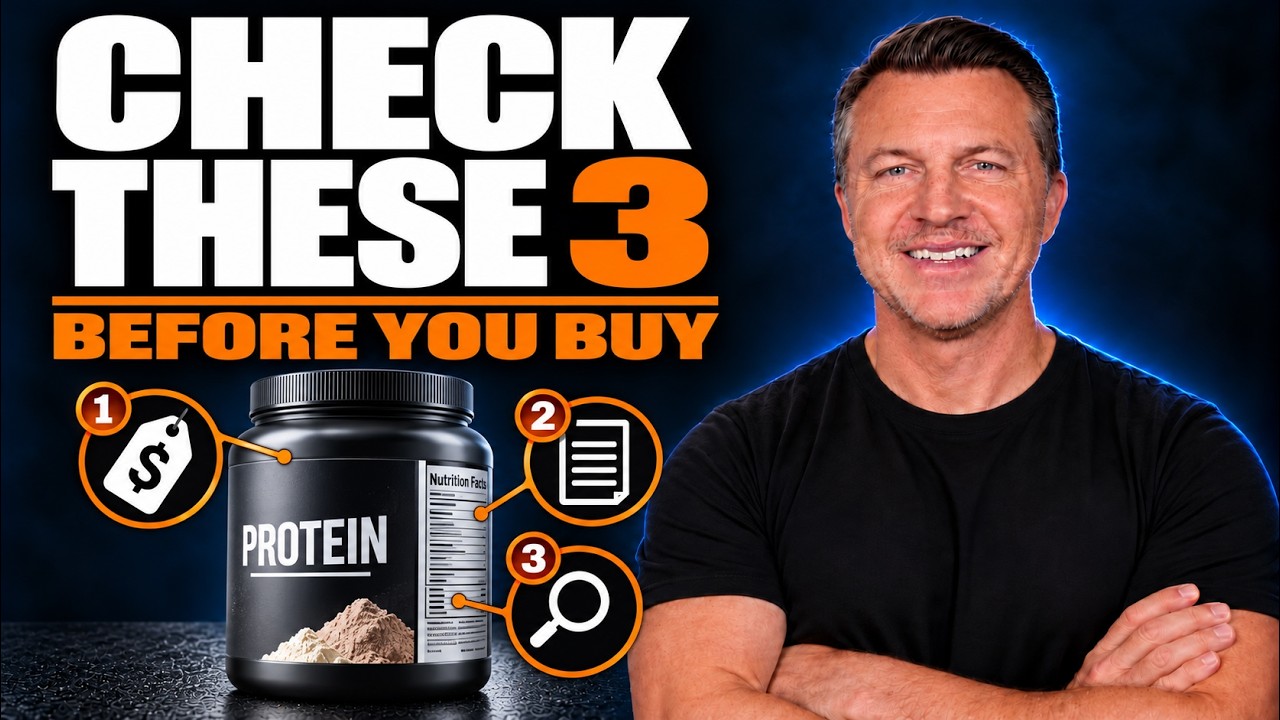
Before buying another protein powder after 50, I want to separate three questions: What does the protein actually cost? Does the formula fit my needs? And who independently checked it?
I’m Joe: 50, married, four kids, and a full-time job. Function Over 50 is where I put the research into practice and show my work. Here is the buying checklist from my latest video.
1. Compare the cost of the protein—not just the tub
A $30 tub looks cheaper than a $40 tub. That tells me what I will spend at checkout, but not how much protein I am buying.
Here are the made-up examples from the video. These are not current product prices or brand recommendations.
| What you are buying | Tub A | Tub B |
|---|---|---|
| Container price | $30 | $40 |
| Servings | 20 | 30 |
| Protein per serving | 20 g | 25 g |
| Total protein | 400 g | 750 g |
| Cost per 25 g of protein | $1.88 | $1.33 |
Assuming the protein sources and quality are comparable, Tub B gives me more protein for each dollar—even though the container costs more.
The calculation: container price ÷ (servings × grams of protein per serving) × 25.
I am using 25 grams as a measuring stick, not prescribing the perfect serving size for everybody. Use the same comparison amount for each product, and include shipping or other costs if they change what you actually pay.
A scoop of powder is not a scoop of pure protein
A 30-gram serving of powder might contain 20 grams of protein. Those are different numbers. Read the protein line and check whether the stated serving requires one scoop or more.
But there is a catch: equal protein grams do not automatically mean two powders are equally suitable for my goal. That is the second check.
2. Choose a protein source and formula that fit you
The useful question is not which label sounds most advanced. It is whether the protein source, ingredients, and serving fit my body, diet, and muscle-building plan.
Whey concentrate versus whey isolate
Both are milk proteins. Isolate undergoes further processing to concentrate the protein and remove more lactose and fat, as described in this research overview of protein sources. The finished flavored product can contain other ingredients, so the word “isolate” is not a substitute for reading its label.
Less lactose can matter if lactose bothers your stomach. It does not mean every isolate is completely lactose-free or that everyone will tolerate it. The NIH’s NIDDK explains that lactose tolerance varies and lactose intolerance is different from a milk allergy. Whey is still milk protein; low lactose does not make it a safe alternative for someone with a milk allergy.
For me, paying more for a formula I tolerate can make sense. Paying more because “isolate” sounds like a guarantee of extra muscle is a different argument.
Plant-based does not automatically mean ineffective
In a 12-week randomized trial by Lynch and colleagues, young adults combined resistance training with soy or whey supplements matched for leucine. The researchers found no significant between-group differences in gains in lean mass and strength.
The details matter: participants were ages 18–35, and the supplements provided different amounts of total protein—26 grams of soy versus 19 grams of whey—to supply the same two grams of leucine. This was not an over-50 study or proof that every plant powder equals every dairy powder.
It is a reason to look at the actual formulation instead of dismissing a product simply because it is plant-based.
Collagen is not a straight swap for whey
Collagen is protein, but its amino acid profile differs from whey’s, including much less leucine in the products studied.
In a small randomized trial involving 22 healthy older women, whey produced greater muscle protein synthesis responses than collagen during acute testing and a six-day supplementation period. Muscle protein synthesis is the process of making muscle protein—not a direct measurement of years of muscle gain.
That supports my decision not to treat collagen as a gram-for-gram replacement for my main muscle-building protein. It does not settle every possible use of collagen.
Read the rest of the formula, too
Check calories, added sugar, allergens, and ingredients you need to avoid. A product that fits someone else’s diet may not fit yours.
Also, total sugar and added sugar are not interchangeable. The FDA explains that total sugars include naturally occurring sugars, such as those in milk, as well as added sugars. Zero sugar is one label detail—not a complete verdict on the product.
3. Verify the independent testing claim
A good-looking label still leaves a question: who checked whether it matches what is in the tub?
For products sold as dietary supplements in the United States, the FDA does not approve safety and effectiveness before they go on sale. That does not mean there are no rules. Companies are responsible for meeting applicable requirements, and the FDA has inspection and enforcement roles.
Independent certification gives me a claim I can investigate. For example, NSF’s supplement certification includes label-claim, toxicology, and contaminant reviews. Its Certified for Sport program also screens for banned substances.
- Identify the organization behind the testing claim.
- Search its own database for the exact product, not just the brand.
- Match the flavor, version, and lot details where the listing provides them.
- Read what that certification actually checks.
You can start with NSF’s dietary supplement listings or the Certified for Sport product database. A generic “third-party tested” statement without a named tester or clear scope leaves more questions to ask.
Certification does not prove a powder builds more muscle, guarantee zero risk, or establish that I personally need it. It adds confidence about the things that particular program checks.
Where my own protein powder fits
Taste and convenience still matter. An excellent powder I will not drink is not useful to me.
If you want to see the powder currently listed in my routine, here is the protein powder linked from my shop. You can also visit the Nutrition & Fuel section for my current picks. These are personal-use links, not a claim that a product beats the alternatives or has a certification I have verified here.
Affiliate disclosure: As an Amazon Associate, I earn from qualifying purchases. If you purchase through my Amazon link, I may earn a commission at no additional cost to you.
Start with the meals, then decide whether you need a shake
Being over 50 does not automatically mean I need more protein powder. A shake can be a convenient way to fill a gap. It is not a replacement for meals or training.
If you are still working out your overall intake, read How Much Protein Do You Need to Build Muscle After 50? For the training side, see my article on working sets and muscle growth after 50.
Make your protein plan a food plan
The free Function Over 50 High-Protein Playbook offers practical meal ideas. Plan a couple of meals, then decide whether a shake would help fill what is missing.
The bottom line
Before I buy another tub, I want three answers: the cost for the same amount of protein, a source and formula that fit my needs, and independent verification I can confirm.
The goal is not buying the cheapest container or the most impressive label. It is knowing what I am paying for—and why it belongs in my plan.
Sources and further reading
- Lynch and colleagues, 2020: leucine-matched soy and whey during resistance training
- Oikawa and colleagues, 2020: whey, collagen, and muscle protein synthesis in older women
- Hoffman and Falvo, 2004: protein sources and whey processing
- NIH NIDDK: lactose intolerance and milk allergy are different
- FDA: total sugars versus added sugars
- FDA: dietary supplement oversight and safety
- NSF: dietary supplement certification
- NSF: Certified for Sport and product verification
This article is educational and shares my research and experience. I am not a doctor, dietitian, or trainer. It is not personalized medical advice. Consult a qualified healthcare professional before starting or changing a supplement, diet, or exercise program, particularly if you have a health condition, take medication, or have food allergies.